Do Identical Settings Give an Identical Picture? Five Styles, Two Cards, Compared
15 August 2026
Last time I had an Intel Arc B580 and an RTX 3090 produce the same picture and measured speed and power. They came out roughly level.
Something had been nagging at me the whole time I was measuring. Can two GPUs from different manufacturers actually produce the same picture?
They are given the same model and the same settings, so in principle the same thing should come out. But the computing is done by cards from different vendors, built to entirely different designs. Do they really match?
This is a record of measurements taken here, on 15 August 2026.
The previous article is here.
 https://kimono-oyaji.com/arc-b580-vs-rtx3090-speed-power-en/
- 1. How I tested it: five styles, same settings, side by side
- 2. Putting a number on the difference between two images
- 3. Of the five, only anime came out noticeably further apart
- 4. Why identical settings do not give identical pictures
- 5. Does it matter in practice that the pictures differ?
- 6. How far this goes: what this article cannot tell you
- 7. In summary: not the same picture, but close enough in practice
- 8. Hardware used in this test
How I tested it: five styles, same settings, side by side
Comparing one image would not be very interesting, so I prepared five styles: photographic, anime, watercolour, line art and cyberpunk.
I wanted to see whether the style changes how the difference shows up. Same model, same settings, same random seed — the only variable is the graphics card.
The top row is the RTX 3090, the bottom row the Arc B580.
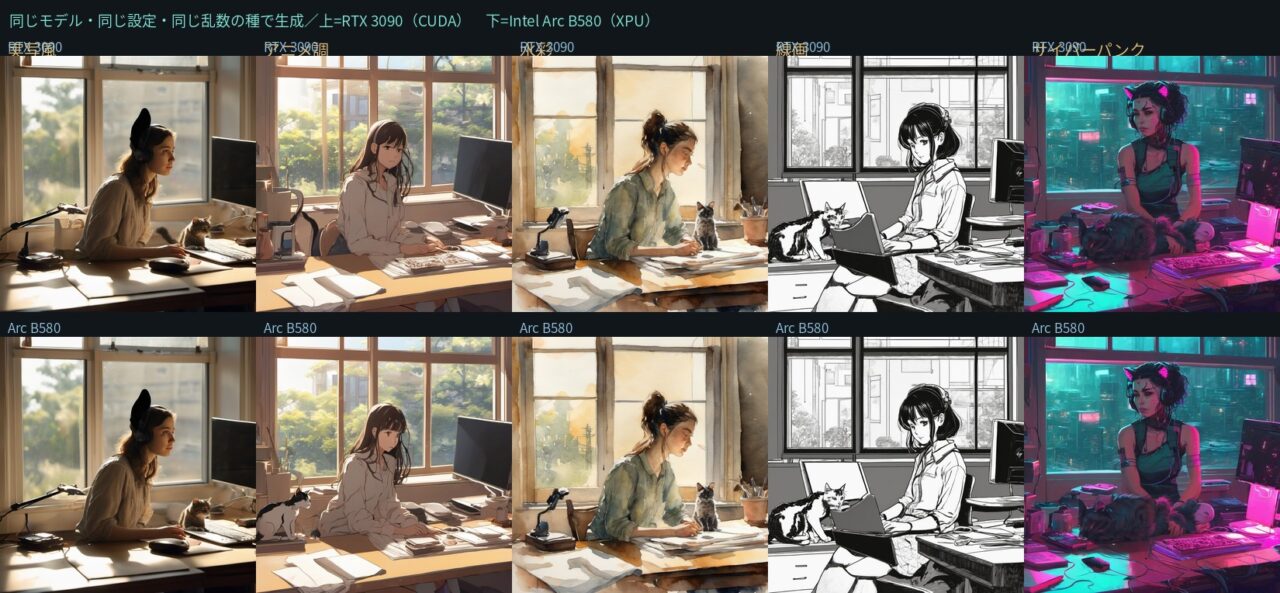
At a glance you cannot tell which is which. Composition, colour and the feel of each style are all preserved.
They did not come out identical, though. Look closely and the details drift, a little at a time.
Putting a number on the difference between two images
An impression is not much to go on, so I measured how close the two images actually are. Higher PSNR means closer; SSIM closer to 1 means closer.
| Style | PSNR | SSIM | Mean pixel difference |
|---|---|---|---|
| Cyberpunk | 35.12 dB | 0.960 | 2.7 / 255 |
| Watercolour | 34.10 dB | 0.963 | 2.1 / 255 |
| Photographic | 32.06 dB | 0.971 | 2.6 / 255 |
| Line art | 24.63 dB | 0.945 | 4.8 / 255 |
| Anime | 22.05 dB | 0.801 | 11.3 / 255 |
The right-hand column is the easiest to read. On a brightness scale of 0 to 255, the average difference is between 2 and 11. Small enough that you would not notice without the two side by side.
Of the five, only anime came out noticeably further apart
What jumps out of the table is that anime sits in a different bracket from the rest. A mean difference of 11.3 is four to five times the other styles. In the comparison image above, the anime pair is the one where the cat has shifted slightly.
Why?
Most likely it is the nature of the style itself. Anime has hard outlines and flat fill. In a picture like that, a line moving by one pixel swaps the colour of that spot outright.
In something soft like watercolour, a small shift blends into the neighbouring colour and goes unnoticed. And sure enough, watercolour and photographic were the closest matches.
The style is decided by the model. The graphics card is just a box that performs the arithmetic. The B580 is not bad at anime.
What is actually true is that the style changes how visible a tiny difference in arithmetic becomes. Anime is not harder for the card — it is where the difference shows.
Why identical settings do not give identical pictures
If the arithmetic is the same, why do the results drift?
In floating-point arithmetic, changing the order of additions produces a tiny error on its own. A graphics card runs thousands of calculations at once, and a different design means a different order. That last-digit difference grows, a little at a time, across twenty steps.
This non-reproducibility is not specific to the B580. Two NVIDIA cards of different generations do the same thing. It is a long-known property of image generation.
Does it matter in practice that the pictures differ?
For how I work, no. When I make an image for this blog I pick the one I like; it does not need to match anyone else’s output to the pixel.
Where it would matter:
- Handing someone the settings for an image you liked and wanting them to reproduce the same picture
- Changing settings one at a time and wanting to see only that difference (generate on a different card and the card’s difference is mixed into what you are looking at)
- Nudging the same picture step by step to build an animation
All of these are avoided by staying on one card. It amounts to not changing hardware partway through.
How far this goes: what this article cannot tell you
PSNR and SSIM are the kind of numbers whose values shift with how they are computed. The ones here I computed myself. Use the similarity figures in this article only for comparison within this article. Lining them up against numbers from elsewhere means nothing.
One pair per style was compared. A different random seed could reorder them. Read “anime shows the difference most" as a tendency visible in these five pairs, not a rule.
Only one model was used (SDXL 1.0), at one resolution and one step count. Whether other models drift more or less is untested.
In summary: not the same picture, but close enough in practice
- Identical settings do not produce identical pictures. But the difference only shows with the two side by side
- In brightness terms, the gap stayed at an average of 2 to 11 out of 255
- Anime differed most. The harder the outlines and the flatter the fill, the more visible a small difference becomes
- This is not a strength or weakness of the card. It comes from the order the arithmetic is done in, and happens between NVIDIA generations too
- For work that needs reproducibility, do not change cards partway through
Across three articles I have looked at image generation on a B580. Getting it running took some climbing, but past that it simply works. Speed matches a 3090, power is half, and the difference in the pictures is within what practice can ignore.
If you want to try image generation and would rather keep the budget down, the B580 looks like a real option to me — provided you know about the setup wrinkle and the fault in the first few images after startup.
Next I want to do the same thing with a much larger model. That is where 12GB should actually start to bite.
Hardware used in this test
Intel Arc B580 Graphics Card (12GB)
As an Amazon Associate we earn from qualifying purchases.
NVIDIA GeForce RTX 3090 24GB24GB VRAM, runs 27B-32B
Test environment: Ubuntu 24.04.4 / kernel 7.0.0-28 / RTX 3090 24GB + Intel Arc B580 12GB (both in the same desktop) / ComfyUI v0.16.4 / SDXL 1.0 / 1024×1024, 20 steps, identical seed. Measured 15 August 2026.
- Does image generation run? Trying it without touching the host
- Speed and power against an RTX 3090 on the same picture
- Do the same settings produce the same picture? (this article)
- Slow local LLMs? A driver update made it 3x faster
- Reported as PCIe Gen1 x1 — how I misdiagnosed it
- Speed and power for models that fit in 12GB
- It fits, so why is it slow?
- External GPUs would not work over Thunderbolt
- What happens when you mix GPUs from different vendors
- What worked and what did not