Lenovo Legion 550Pi (GTX 1650): An Entry-Level Gaming Laptop, Put Through VR
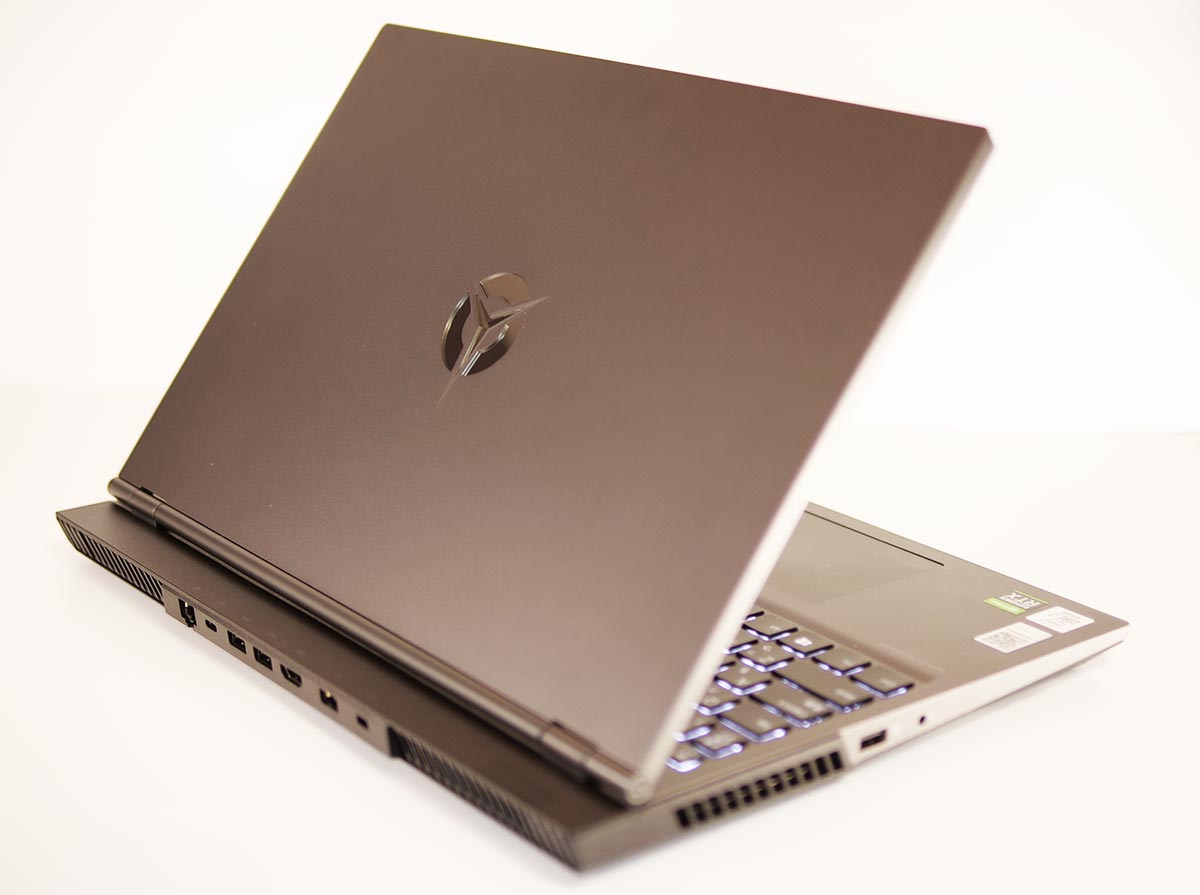
Lenovo lent me a light-duty gaming laptop, the “Lenovo Legion 550Pi." The unit I am testing this time carries a GeForce GTX 1650. How much VR can this model actually handle?
- 1. The Lenovo Legion 550Pi Lineup
- 2. The Test Setup: Lenovo Legion 550Pi (GTX 1650 Model)
- 3. Design and Build
- 4. Weight and Portability
- 5. VR Performance Test Results
- 6. Overall PC Performance
- 7. Standard Benchmark Results
- 8. Power Draw and Noise
- 9. Trying Various Headsets
- 10. What I Could Not Verify
- 11. In Summary: What This Laptop Is Good For
The Lenovo Legion 550Pi Lineup
The Lenovo Legion 550Pi is a gaming laptop that pairs a 10th-gen Intel Core CPU with an NVIDIA GeForce GPU.
| Lenovo Legion 550Pi | Configurations |
| CPU | Intel Core i5-10300H Intel Core i7-10750H (one or the other) |
| GPU | GeForce RTX 2060 GeForce GTX 1660 Ti GeForce GTX 1650 (one of the three) |
| Memory | 8GB or 16GB |
| Chipset | Not disclosed |
| SSD | 512GB or 1TB |
| HDD | None |
| Display | 15.6″ matte LCD 1920×1080 (Full HD) 60Hz or 144Hz |
| Interfaces | HDMI x1 USB 3.0 (Type-A) x4 USB 3.0 (Type-C) x1 Mic/headphone combo jack x1 Wired LAN |
| Networking | Wi-Fi: Wi-Fi 6 (802.11 a/b/g/n/ac/ax) Bluetooth: Bluetooth 5.0 |
| Webcam | None |
| Battery life | Roughly 10.8–11.8 hours (varies by configuration) |
| OS | Windows 10 Home 64-bit |
| Keyboard | Full-size (backlit) |
| Dimensions (W×D×H) | 2.2L (363.1 x 259.6 x 23.6mm) |
| Power adapter | 170W, 230W |
| Weight | ~2.3kg |
| Price (tax included) | From ¥91,331 (as of March 28, 2021) |
*Prices and configurations reflect the time of writing and change frequently. Please check the official site for current details.
The Lenovo Legion 550Pi runs a 10th-gen Intel CPU. Since 11th-gen Intel Core laptops were already reaching the market by this point, this is effectively a late-cycle product.
As of this writing (March 28, 2021), Lenovo’s own store carries 2 configurations, and 3 more configurations are in stock elsewhere.
The Test Setup: Lenovo Legion 550Pi (GTX 1650 Model)

Here is the spec sheet for the unit I borrowed. This is the configuration I am testing throughout this article.
| Model | Lenovo Legion 550Pi |
|---|---|
| Display | 15.6″ FHD IPS LCD (1920x1080px) |
| CPU | Intel Core i7-10750H 6 cores / 12 threads, 2.6GHz (Turbo Boost 5.0GHz) |
| GPU | NVIDIA GeForce GTX 1650 4GB GDDR6 |
| Memory | 16GB |
| SSD | 512GB (NVMe/M.2) |
| HDD | None |
| Power adapter | 170W |
| OS | Windows 10 Home 64-bit |
The Lenovo Legion 550Pi’s GPU comes from the GeForce line. The unit here carries a GeForce GTX 1650 — a “GTX 1650" in name, but this particular one uses the faster GDDR6 memory variant.
Design and Build
The design here is identical to the GeForce RTX 2060 model I reviewed previously.
For the details, see that article:
 https://kimono-oyaji.com/en/lenovo-legion-550pi-rtx2060-en/
Weight and Portability
The Laptop Itself
I weighed the unit.
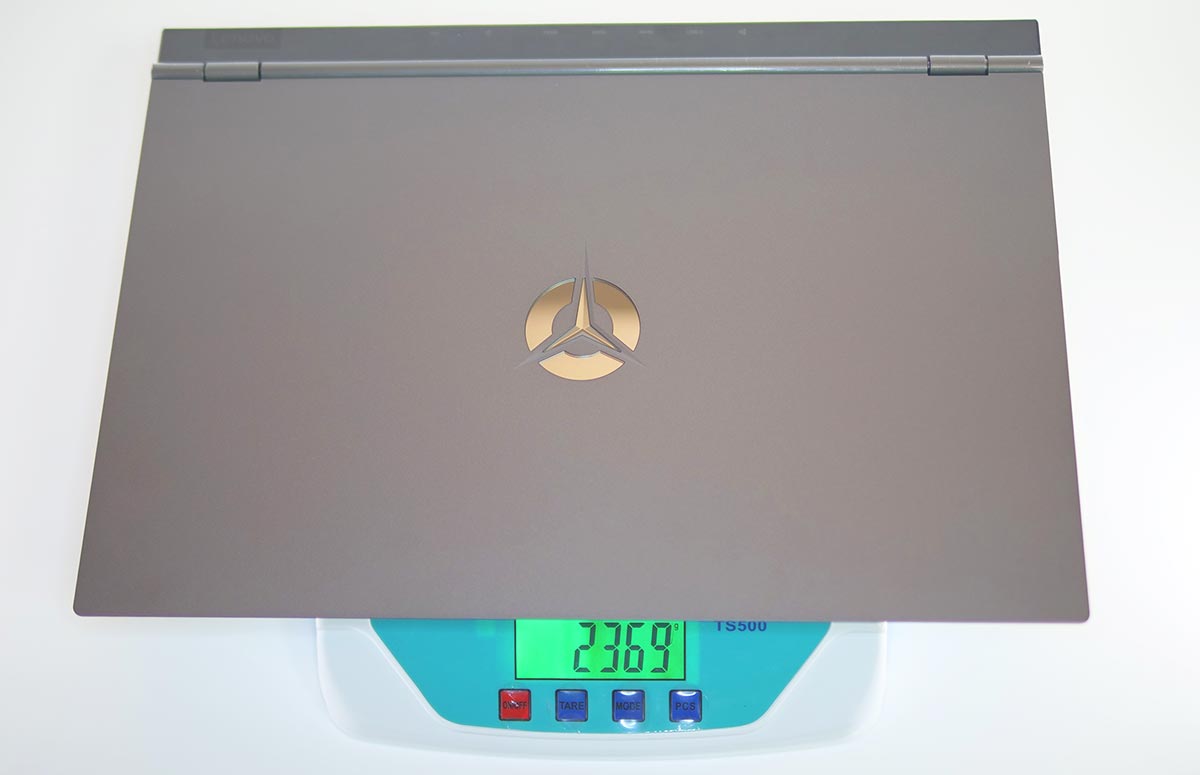
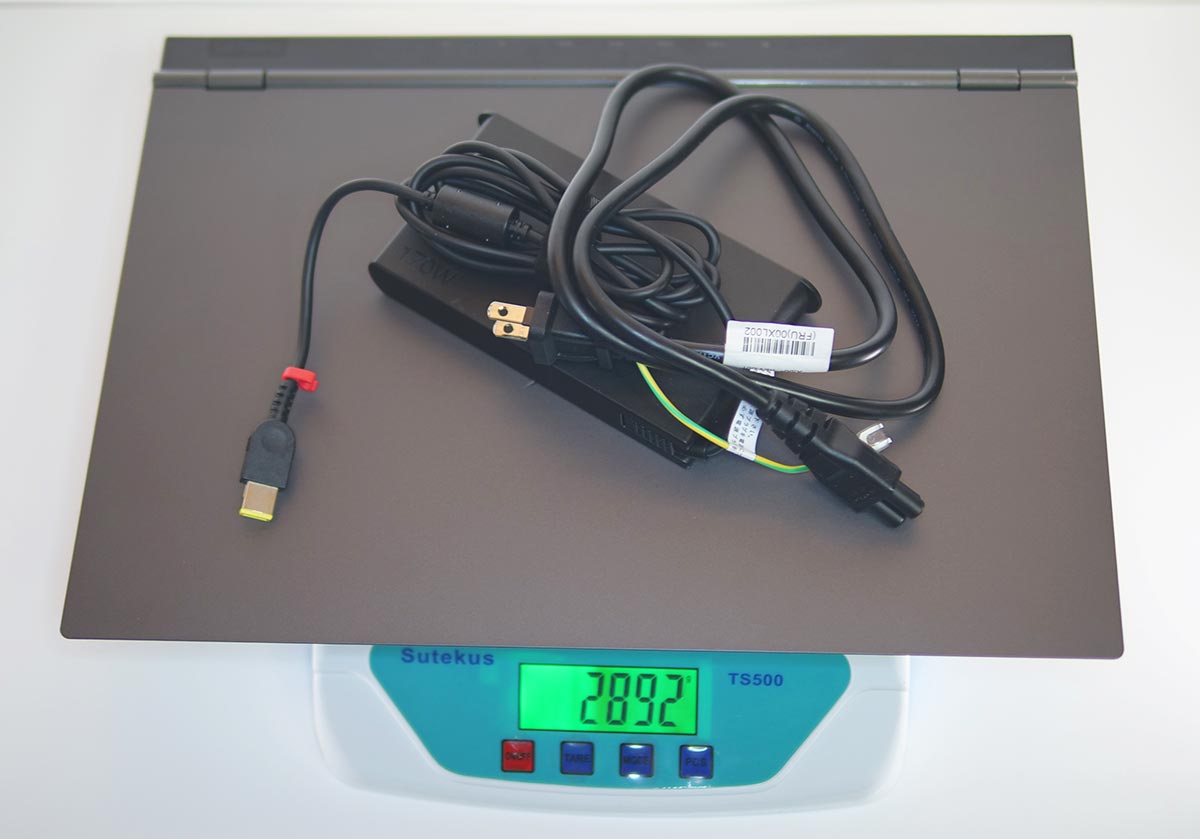
| Item | Weight |
|---|---|
| Laptop only | 2.369kg |
| Laptop + power adapter | 2.892kg |
At roughly 2.4kg for the laptop alone, this is on the heavy side even for a gaming laptop.
Add the power adapter and you are at roughly 2.9kg.
Power Adapter
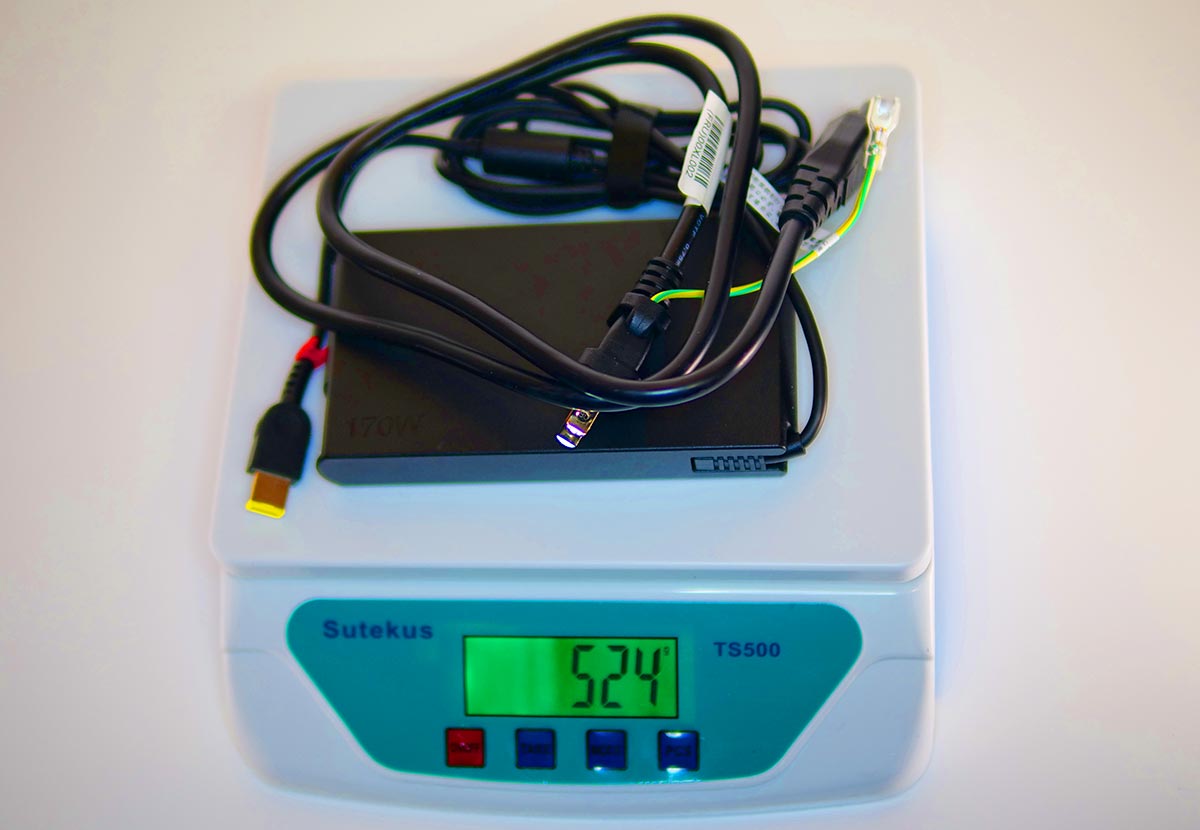
At 170W, the AC adapter is medium-sized as far as gaming laptops go. It is somewhat smaller and lighter than earlier models.
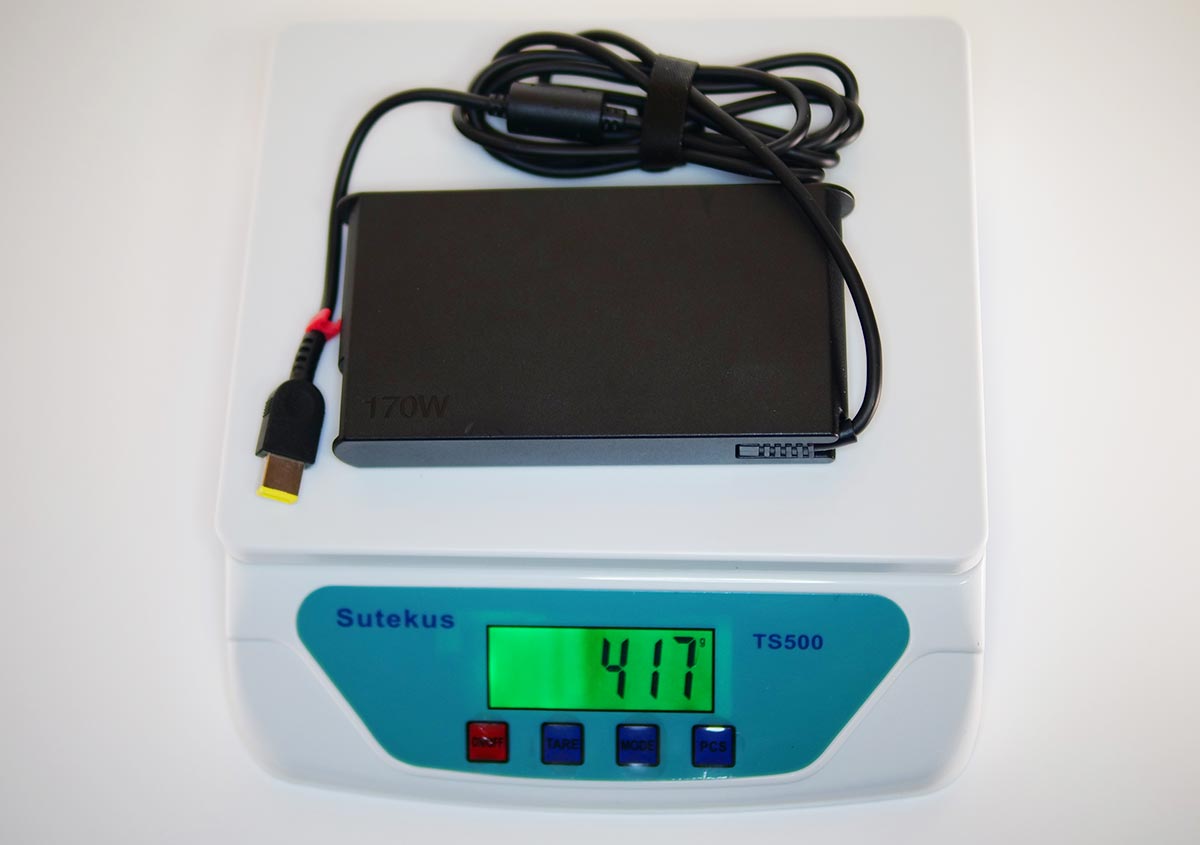
The adapter alone weighs about 400g, and roughly 500g with the cable — light enough that carrying it around does not feel unreasonable.
VR Performance Test Results
From here, I go through the VR performance of the Lenovo Legion 550Pi (GTX 1650 model). This section estimates VR performance from benchmark app scores.
Against the Recommended Oculus Spec
I compared this against a PC built to the minimum recommended Oculus GPU spec:
- CPU: Intel Core i5-4590
- GPU: GeForce GTX 1060 6GB
- Memory: 8GB
The figures below are calculated from measured results.
VR Performance (Legion 550Pi GTX1650)
Relative value, recommended spec = 100
*Lenovo Legion 550Pi (GTX1650 model) performance, with the Oculus recommended spec set to 100
3Dmark TimeSpy shows DirectX 12 rendering performance, and 3Dmark FireStrike shows VR rendering performance using richer graphics than TimeSpy’s “Orange Room" test — both scored against the recommended GTX 1060 6GB desktop set to 100. Cinebench CPU shows overall CPU compute power, and Cinebench SingleCore shows single-core compute power, both against the recommended Core i5-4590 set to 100. The memory score shows RAM capacity against the recommended 8GB set to 100.
Against the Oculus recommended performance, this comes in at roughly 80%.
Resolution Against Frame Rate
I ran VRMark across a range of resolutions. The horizontal axis is pixel count; the vertical axis is frame rate.
Resolution vs. VRMark Score (Legion 550Pi GTX1650)
| 3.1 | 110.2 | 60 | 68 | 72 |
| 5 | 92 | 53 | 51 | 72 |
| 8.3 | 68 | 34 | 37 | 72 |
| 14.7 | 46 | 20 | 23.3 | 72 |
If you are using an Oculus Quest or Quest 2, look at roughly the 10-megapixel mark on the graph to estimate the frame rate you will get. At the default rendering-resolution setting of “1.0," even lightweight apps will likely drop frames. Turn down both resolution and quality in the app settings, and you can get a taste of PC VR.
Lenovo Legion 550Pi (GTX1650 model) VR performance: it does not reach the Oculus recommended spec, landing at roughly 80% of it. High resolution is not realistic, but lightweight apps will give you a taste of PC VR.
VR Score and Cost Performance
Against a score of 100 for the Oculus recommended spec, this comes out to 79.
| Metric | Score |
|---|---|
| VR Score Higher is better performance | 79 |
| VR Cost Performance Higher is better value | 77* |
Overall PC Performance
Here are the results from the PCMark10 benchmark app, which shows how the Lenovo Legion 550Pi (GTX1650 model) performs for non-gaming use.
I compared this against a desktop PC built around an “Intel Core i5-10400."
PC Performance (Legion 550Pi)
Relative value, reference spec = 100
*Lenovo Legion 550Pi (GTX1650 model) performance, with the Intel Core i5-10400 benchmark result set to 100
PCMark10’s “Overall" reflects total PC performance. “Essentials" reflects everyday tasks like launching apps and browsing, measured using real apps and a browser. “Productivity" reflects office-suite work like word processing and spreadsheets, measured with OpenOffice-family apps. “Digital Content Creation" reflects creative work — photo, video, and 3D graphics — measured with apps like GIMP.
It holds its own against a desktop PC without embarrassment.
Lenovo Legion 550Pi (GTX1650 model) baseline performance: it clears the performance of a typical mainstream Core i5 desktop PC. You are unlikely to feel short on power for ordinary work, whatever you are doing.
Standard Benchmark Results
Including the figures above, here are the standard benchmark results side by side. For VR use, this is more than enough performance.
| Benchmark | Score |
|---|---|
| SteamVR Performance Test | Average fidelity: 6.1 (High) Frames tested: 9,612 |
| VRMark | Orange Room: 5,055 Cyan Room: 2,754 Blue Room: 1,068 |
| 3DMark | Time Spy: 3,789 Fire Strike: 8,700 |
| PCMark10 | OVERALL: 5,277 Essentials: 8,827 Productivity: 7,879 Digital Content Creation: 5,734 |
| CINEBENCH R20 | CPU: 3,084 Single Core: 496 |
| FINAL FANTASY XV | High quality: 3,956 (Standard) |
| FINAL FANTASY XIV | Maximum quality: 10,336 (Extremely comfortable) |
Even the comparatively heavy “Final Fantasy XV" runs at high quality without trouble.
Storage
The C Drive
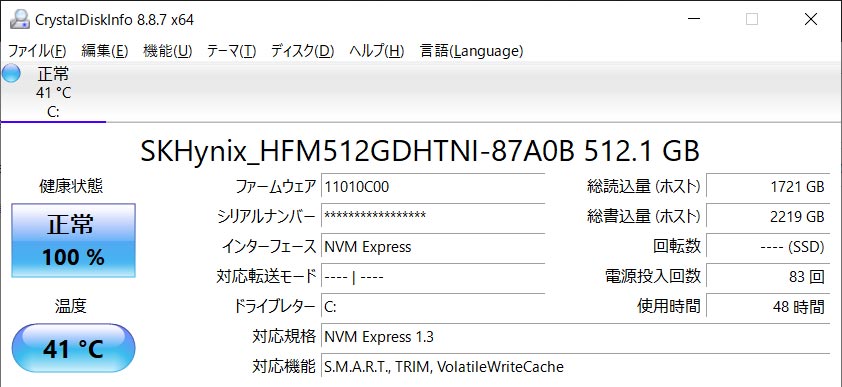
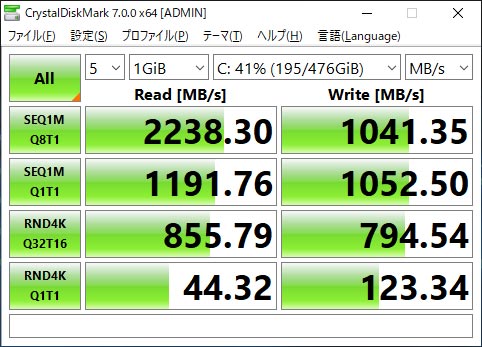
The unit carries an SK Hynix SSD supporting PCIe 3.0 x4.
Sequential read comes in above 2,000MB/s — a middling speed for an M.2 SSD.
Power Draw and Noise
For reference, I measured power draw and noise. The battery was at 100%, with the fan mode set to “Performance."
| State | Power draw | Noise |
|---|---|---|
| Powered off | 0W | 32dB |
| Idle (“Performance" mode) | 25W | 38dB |
| Under load (3DMark) | 166W | 51dB |
Once the fan spins up, you hear a whooshing sound. It appears to ramp fan speed in steps rather than running flat-out constantly. Even during VR use, it stays surprisingly unobtrusive.
Trying Various Headsets
I checked what kind of frame rate you get with each headset.
Wiring for DisplayPort Headsets
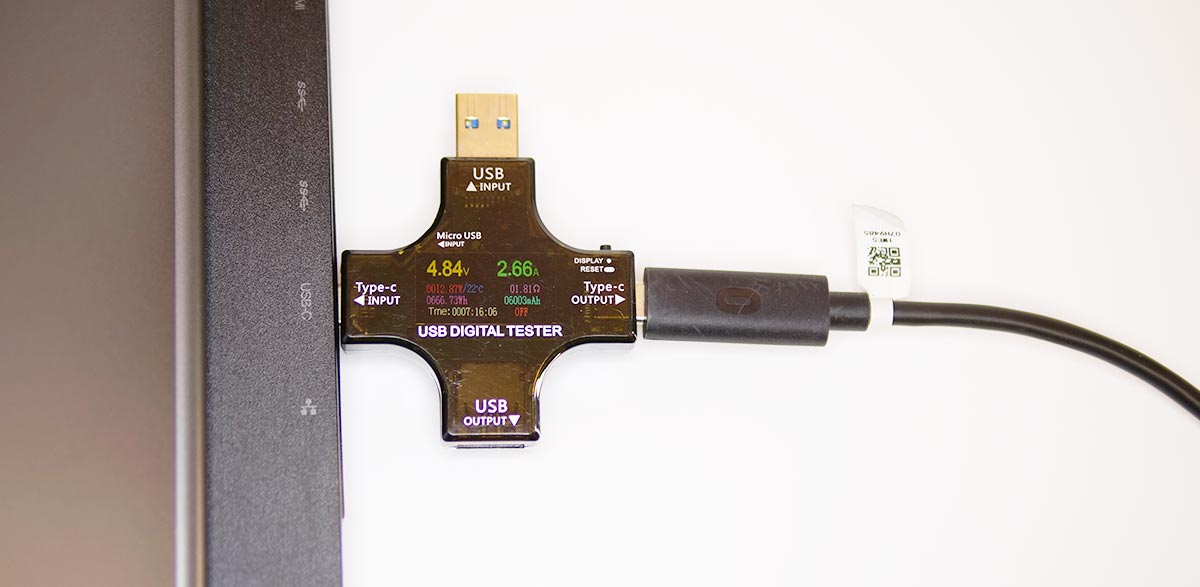
The Lenovo Legion 550Pi (GTX1650 model) has no DisplayPort of its own, but attaching a DisplayPort adapter to the rear USB Type-C port lets you connect an Oculus Rift S, a Vive-series headset, and similar devices.
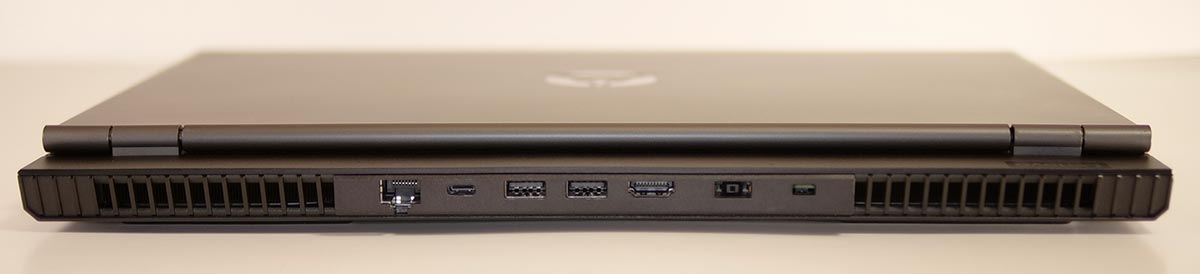
The neighboring USB port also supports USB 3.0, so the cabling stays tidy.
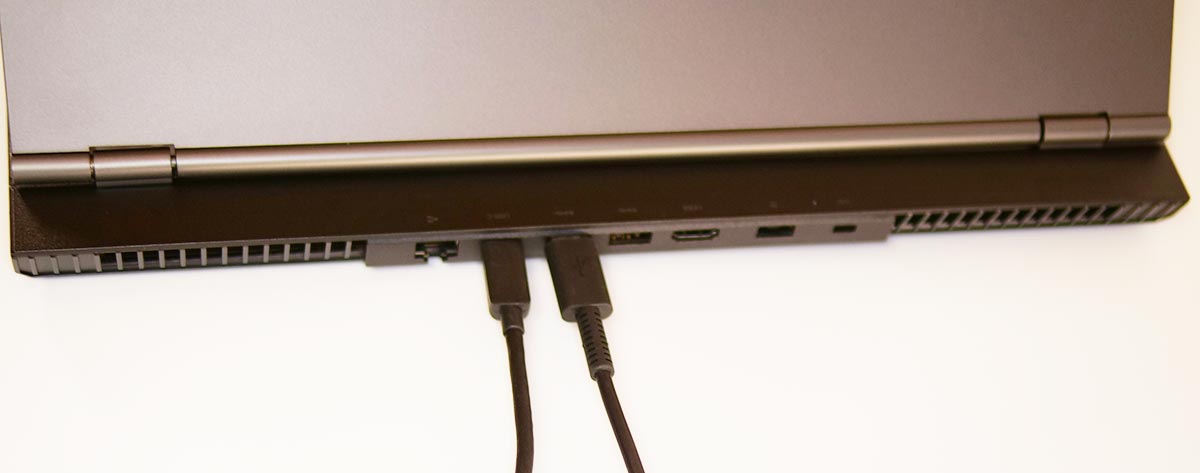
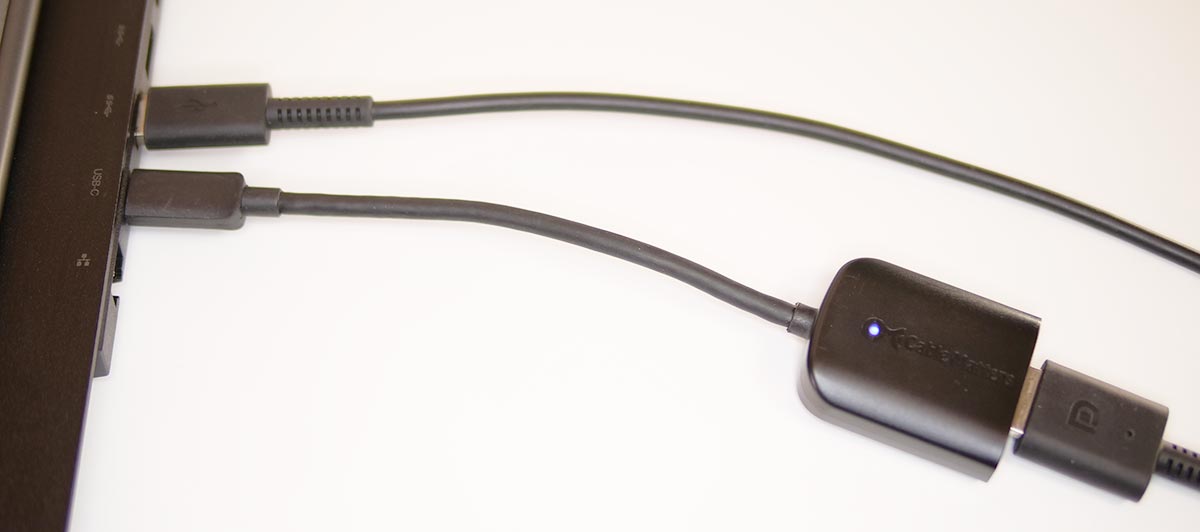
Here is the adapter I used.
Oculus Rift S
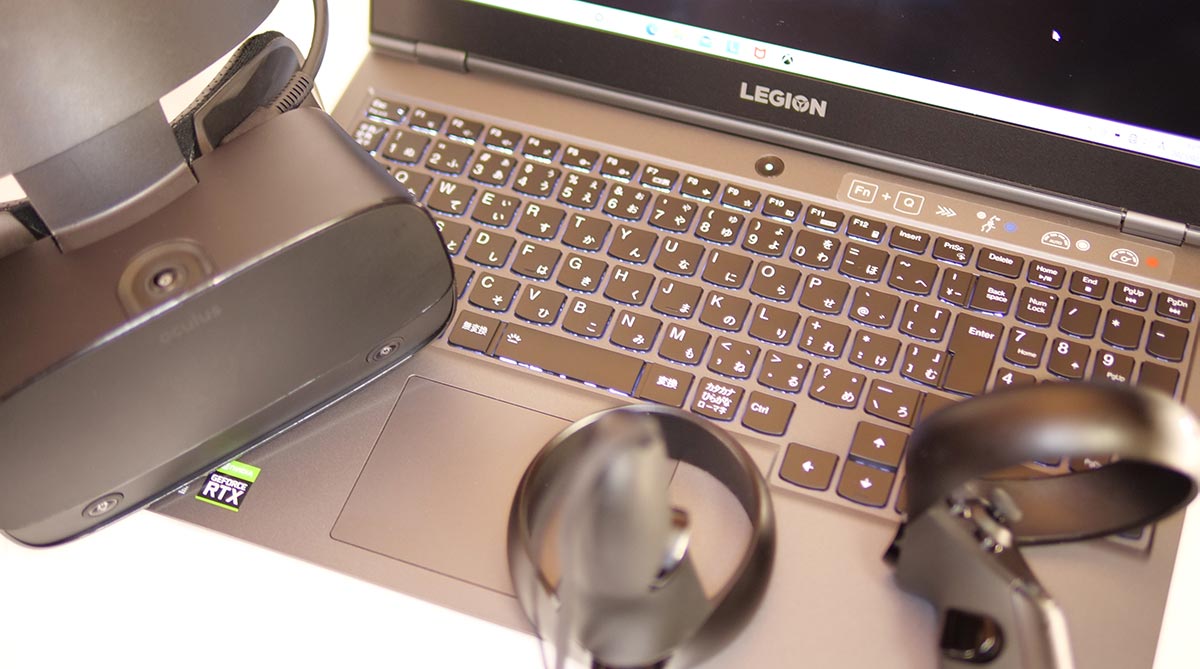
The Oculus Rift S refreshes at 80Hz. I measured the frame rate in each app.
Prioritizing Quality
With the Oculus app set to “Prioritize quality," here is the frame rate for each app.
Oculus Rift S (Quality priority) x Legion 550Pi (GTX1650)
Even a heavy VR app like “Asgard’s Wrath" is playable, if barely, once you drop it to “easy" quality. That is more comfortable than I expected.
The heavier “Medal of Honor" drops frames badly and is not really playable.
Prioritizing Performance
With the Oculus app set to “Prioritize performance," here is the frame rate for each app.
Oculus Rift S (Performance priority) x Legion 550Pi (GTX1650)
The frame rate barely changed even after switching the Oculus app’s priority setting.
Asgard’s Wrath is just barely enjoyable at “easy" quality, but Medal of Honor remains rough.
In principle, this setting should have raised the frame rate. Something in the background may have been competing for resources, but this still gives a reasonable picture of how each app behaves.
Vive Cosmos Elite
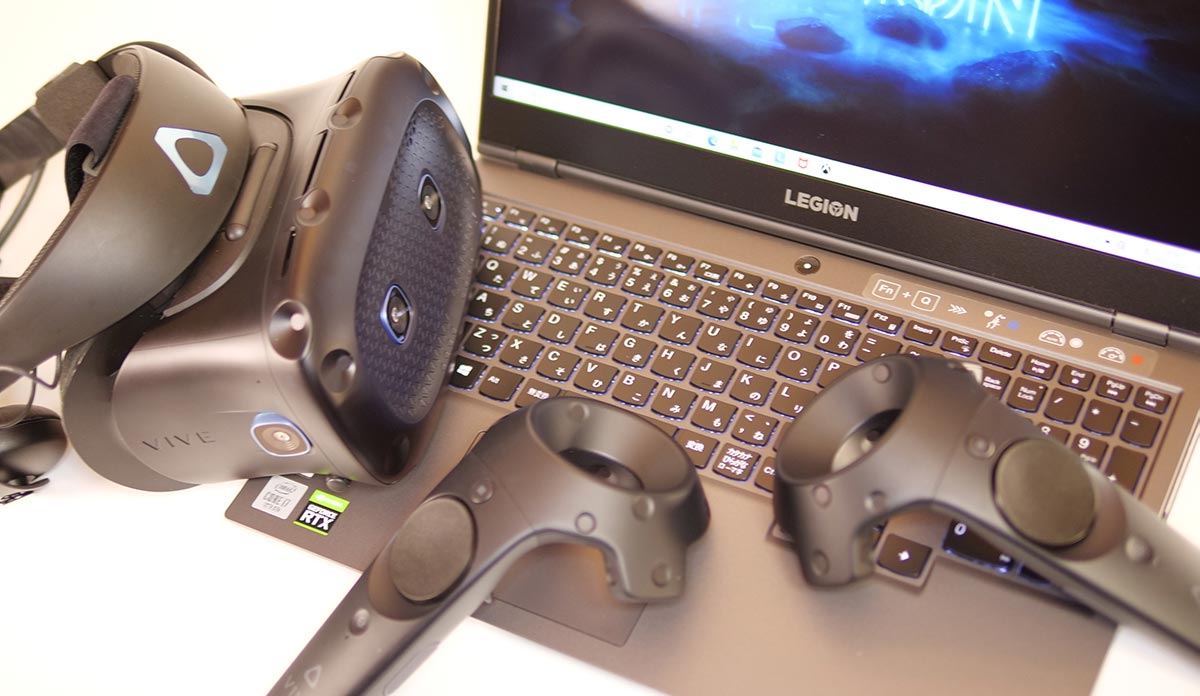
The Vive Cosmos Elite refreshes at 90Hz. I measured the frame rate in each app.
Rendering Resolution: 100% (2016×2380)
I set the video supersampling setting to 100% (per-eye resolution: 2016×2380) and measured the frame rate in each app.
Asgard’s Wrath and Medal of Honor could not even be measured — they simply took too long to start up.
Vive Cosmos Elite (SS 100%) x Legion 550Pi (GTX1650)
A PC with a GTX 1650 appears to be too little for the Vive Cosmos Elite.
Rendering Resolution: 50% (1424×1680)
I set the video supersampling setting to 50% (per-eye resolution: 1424×1680) and measured the frame rate in each app.
Vive Cosmos Elite (SS 50%) x Legion 550Pi (GTX1650)
At this setting, lighter apps become playable. That said, I would not say VR is genuinely enjoyable here.
Pimax 8K Plus
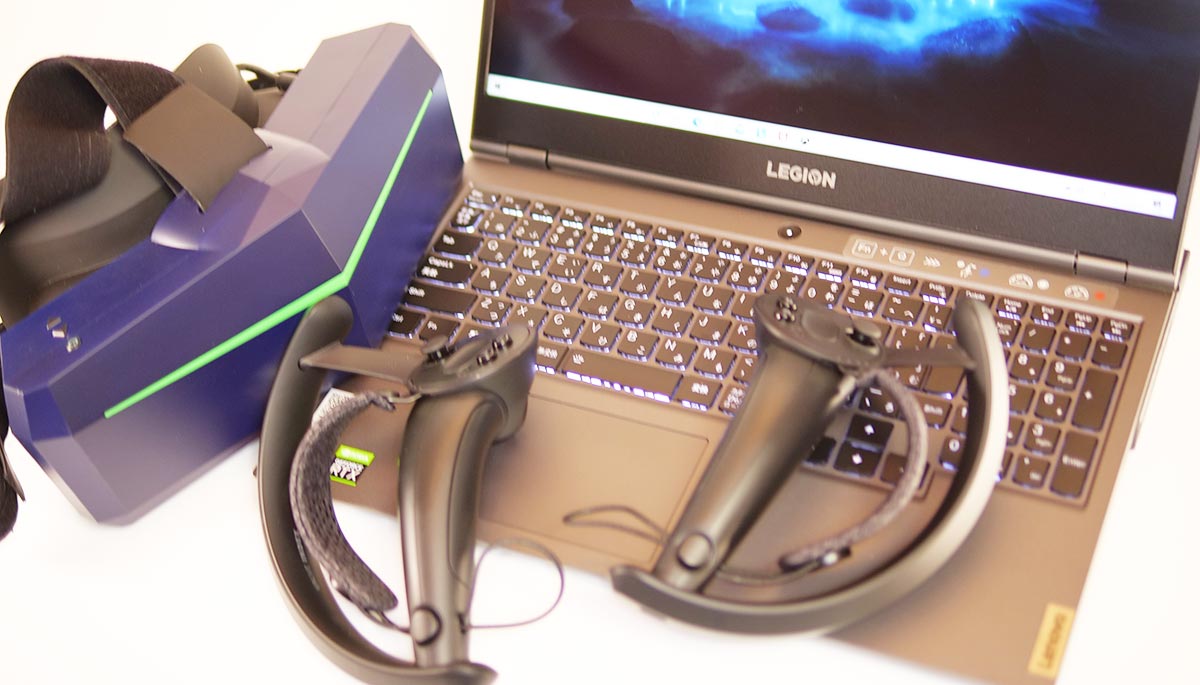
The Pimax 8K Plus can refresh at 72Hz, 90Hz, or 110Hz. I measured the frame rate in each app.
Field of View “Normal" (per eye: 3080 x 2632)
I checked the frame rate with the Pimax 8K Plus’s field-of-view setting at “Normal" (resolution, per eye: 3080 x 2632). This setting gives a wide field of view and strong immersion.
Pimax 8K Plus (Normal) x Legion 550Pi (GTX1650)
At this setting, even lightweight apps start dropping frames easily.
Enjoying VR at this wide a field of view seems to be a stretch with this hardware.
Field of View “Normal," SS 50% (per eye: 2176 x 1860)
I kept the Pimax 8K Plus’s field-of-view setting at “Normal," set SteamVR supersampling to 50% (resolution, per eye: 2176 x 1860), and checked the frame rate. This gives a wide field of view and strong immersion, but a somewhat soft, blurry image.
Pimax 8K Plus (Normal, SS 50%) x Legion 550Pi (GTX1650)
Lowering supersampling makes lightweight apps just about enjoyable.
The image is somewhat soft, but the wide field of view does add to the sense of immersion.
Personally, if you are going to use an expensive headset like this, I would recommend a PC with a GPU to match.
Field of View “Small" (per eye: 2228 x 2632)
I checked the frame rate with the Pimax 8K Plus’s field-of-view setting at “Small" (resolution, per eye: 2228 x 2632). This setting still gives a wider field of view than a typical headset.
Pimax 8K Plus (Small) x Legion 550Pi (GTX1650)
Heavy apps and quality-focused settings drop below 72fps here. “Medal of Honor" is a lost cause at this setting too.
Field of View “Potato" (per eye: 1776 x 2632)
I checked the frame rate with the Pimax 8K Plus’s field-of-view setting at “Potato" (resolution, per eye: 1776 x 2632). This setting gives a narrow field of view — you are not really getting what makes the Pimax 8K Plus worth using.
Pimax 8K Plus (Potato) x Legion 550Pi (GTX1650)
Heavy apps and quality-focused settings still drop below 72fps. “Medal of Honor" manages to launch here, but it is not comfortable.
Wiring for the Oculus Quest Series
The Lenovo Legion 550Pi (GTX1650 model) has a USB Type-C port on the back, so plugging an Oculus Quest or Quest 2 in there gives you fast charging plus uninterrupted Oculus Link.
Oculus Quest
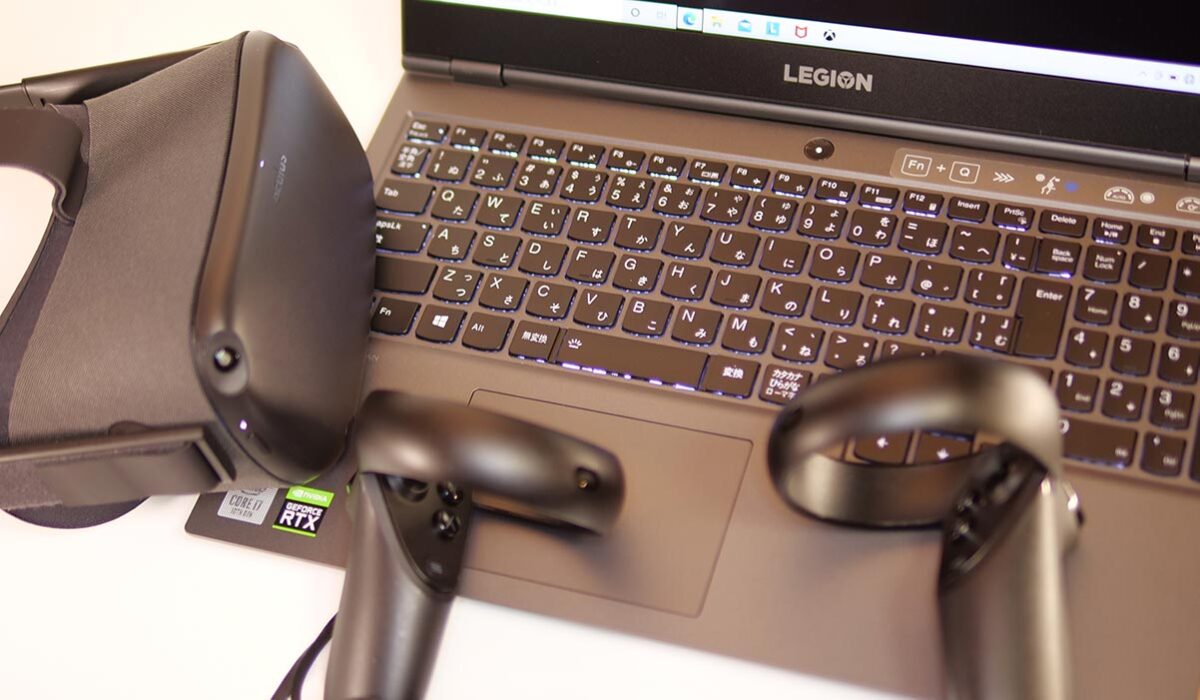
The Oculus Quest refreshes at 72Hz. I measured the frame rate in each app.
Default Setting (4128 x 2272)
I left the PC-side Oculus app’s rendering resolution at the middle “1.0x" setting (resolution: 4128 x 2272) and measured the frame rate in each app.
Oculus Quest (resolution 1.0x) x Legion 550Pi (GTX1650)
Something on the order of Skyrim or Half-Life: Alyx runs without a problem.
Even a heavy app like Asgard’s Wrath manages to launch, but pushing for high quality causes frame drops. For smooth play, it seems better to lower the rendering resolution.
Medal of Honor is a lost cause here.
Frame-Rate-Focused Setting (3104 x 1712)
I set the PC-side Oculus app’s rendering resolution to the minimum “0.8x" (resolution: 3104 x 1712), the setting that should maximize frame rate. This produces a soft, heavily-compressed-looking image, but with stable performance.
Oculus Quest (resolution 0.8x) x Legion 550Pi (GTX1650)
This should be the setting that gets the most frame rate out of the Oculus Quest, but the numbers did not come out especially high. Some other process may have been competing for resources, but the basic pattern holds: heavy apps still play back like a slideshow.
On the Oculus Quest, it is fair to write off Asgard’s Wrath and Medal of Honor as unplayable.
Quality-Focused Setting (5408×2976)
I set the PC-side Oculus app’s rendering resolution to the maximum “1.3x" (resolution: 5408×2976), the setting that maximizes image quality, and measured the frame rate.
Oculus Quest (resolution 1.3x) x Legion 550Pi (GTX1650)
This setting maximizes image quality, but frame rate falls apart.
Apps that were already dropping frames at the default setting drop even more here — some are effectively a slideshow.
Oculus Quest 2
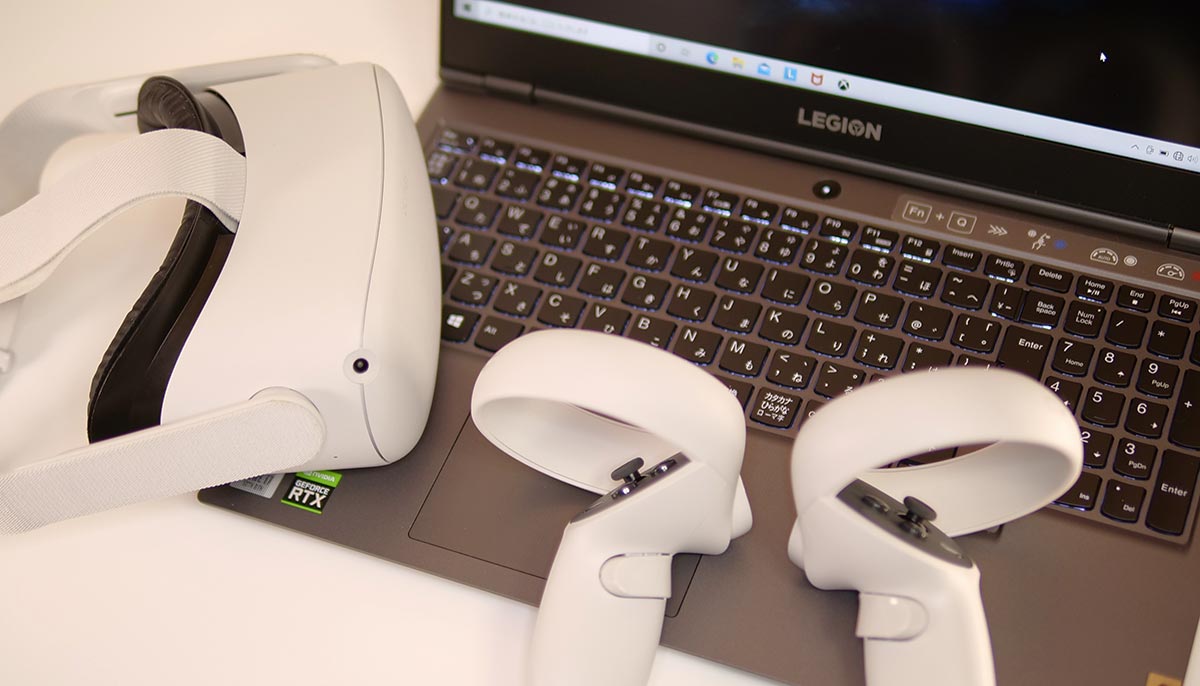
The Oculus Quest 2 can refresh at 72Hz, 80Hz, or 90Hz. I measured the frame rate in each app.
Default Setting (4128 x 2096)
I left the PC-side Oculus app’s rendering resolution at the middle “1.0x" setting (resolution: 4128 x 2096) and measured the frame rate in each app.
Oculus Quest 2 (resolution 1.0x) x Legion 550Pi (GTX1650)
Lightweight apps run without a problem. Something like Skyrim or Half-Life: Alyx should be perfectly playable.
Asgard’s Wrath and Medal of Honor are dropping frames and do not run smoothly.
Frame-Rate-Focused Setting (2784 x 1408)
I set the PC-side Oculus app’s rendering resolution to the minimum “0.7x" (resolution: 2784 x 1408), the setting that should maximize frame rate. This produces a soft, heavily-compressed-looking image, but with stable performance.
Oculus Quest 2 (resolution 0.7x) x Legion 550Pi (GTX1650)
This is the setting that gets the most frame rate out of the Oculus Quest 2.
Even Asgard’s Wrath becomes comfortable to play here.
The very heavy Medal of Honor still drops frames. Not recommended.
Quality-Focused Setting (5408×2736)
I set the PC-side Oculus app’s rendering resolution to the maximum “1.3x" (resolution: 5408×2736), the setting that maximizes image quality, and measured the frame rate.
Oculus Quest 2 (resolution 1.3x) x Legion 550Pi (GTX1650)
This setting maximizes image quality, but frame rate falls apart.
Lightweight apps like Beat Saber or Skyrim still run frame-drop-free, but on something like Half-Life: Alyx, the GPU can run short on memory, so textures load in late and the image can look smeary. Not a comfortable experience.
What I Could Not Verify
This is a single unit on loan from Lenovo, so I cannot say how much these numbers would vary from one unit to another. I did not test battery life under VR load, and I did not run mining or video-encoding benchmarks on this configuration.
In Summary: What This Laptop Is Good For
I have gone through the performance of Lenovo’s entry-level gaming laptop, the Lenovo Legion 550Pi (GTX1650 model).
What stood out as good:
・An easy-to-use layout with the ports concentrated on the back
・Strong cost performance for the level of power on offer
・PC VR is enjoyable with lightweight apps
What I would not recommend it for:
・At roughly 2.4kg, it is heavy even as a gaming laptop
・Not enough GPU power for serious PC VR
Personally, I find the Legion series’ back-loaded port layout very easy to live with. It keeps the desk tidy since the cabling stays out of the way, and having the power port on the back is a real plus.
Now, the Lenovo Legion 550Pi (GTX1650 model) carries the GTX 1650, the cheapest GPU in the current GeForce lineup.
| Headset | Verdict |
| Oculus Rift S | Comfortable with lightweight apps. |
| Oculus Quest | Usable with lightweight apps, if you turn down image quality. |
| Oculus Quest 2 | Usable with lightweight apps, if you turn down image quality. |
| Vive Cosmos Elite | Cannot deliver its full performance. Even at 50% supersampling or lower, it still falls short. |
| Pimax 8K Plus | Cannot deliver its full performance. At 50% supersampling or lower, lightweight apps become usable, if barely. |
Against the Oculus recommended PC spec, this only reaches about 80% of the performance. That is fine for a taste of lightweight VR apps, but once you want to go deeper, you will need to upgrade the PC.
Personally, if VR is the point, I would recommend a model with at least a GTX 1660 Ti or an RTX 2060.
That said, the Legion 550Pi has a standard keyboard layout, so it feels perfectly normal for regular work. There are also configurations with Microsoft Office bundled in, so it can pull its weight outside of gaming too.